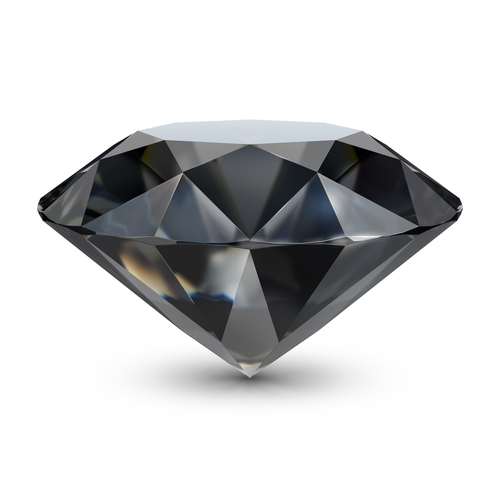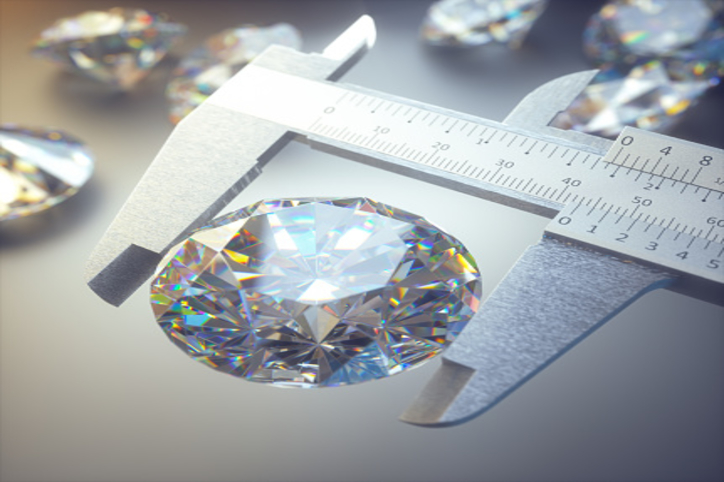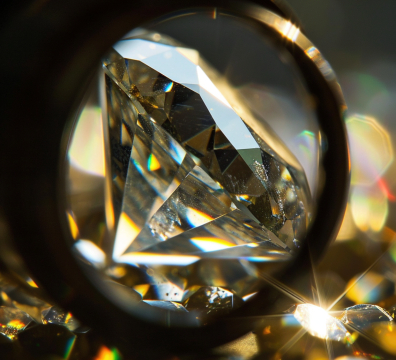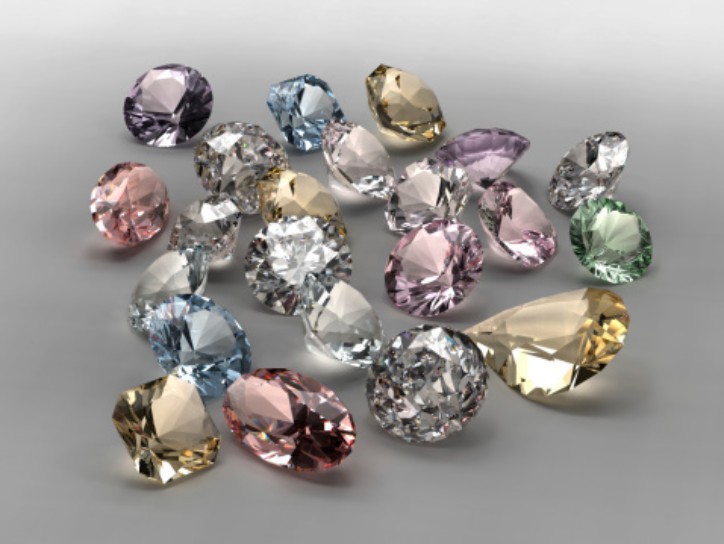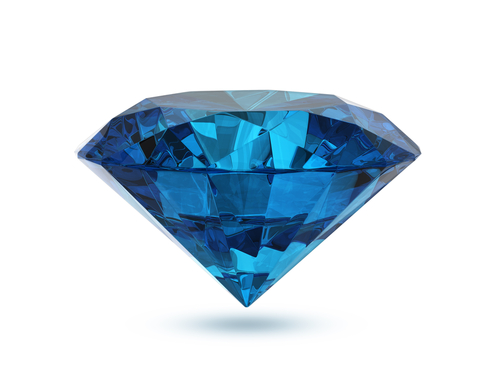

Perhaps part of the fascination of colored stones is that no two of these diamonds will be 100% similar. They’ll be unique in shade, with different characteristics in each one, but you can be sure they’re all eye catching, scarce and therefore also valuable. With diamonds, the stones belonging to the ‘Blue’ group are particularly hard to find in the market. They fall into the group of second most scarce of all diamonds.
So, they’re not as rare as red ones or violet colored diamonds, but they’re definitely harder to find than pink gems. Taking a closer look at only blue diamonds, the ones with stronger hues are more difficult to find than others.
How rare are they?
A practical comparison is this:
For every 100 Picasso canvases that are available for bidding at auctions, you’ll only find a single blue diamond. That’s rare! An alternative way of explaining the rarity is this: Eden Rachminov’s book “The Fancy Color Diamond Book” states that 0.1% of all diamonds that have the classification of ‘fancy colored’ get the ‘Type IIb Blue’ diamond label.
So, how do these stones get their attractive hues?
Both the colors, the chemical composition AND the stories behind famous blue diamonds are interesting. Let’s dive in.
What’s Behind the Colors?
In most colored stones, hues are the result of impurities inside. This also applies to blue diamonds and you have boron to thank for the particular color. Boron particles absorb light’s yellow, resulting in a blue reflection. As stated, not all blue diamonds are of the same hue, so you can expect various looks:
- Paler stones that resemble the sky when it’s clear
- Blue reminiscent of steel
- A deep sea-blue
Because of the different types of blues, they’re named accordingly to differentiate between them and you’ll find many descriptions on the market, such as ‘royal’ or ‘baby’.
What Type of Blue Diamond can You Expect?
Types refer to a diamond’s grading and you’ll come across:
- Type IIb: This refers to exceptional purity, referring to the absence of nitrogen impurities, or there are very few of them.
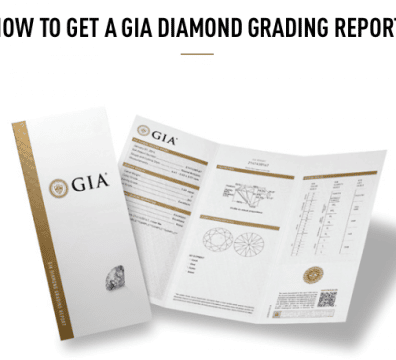
- Type Ia: Here the color is affected by hydrogen and you can expect secondary hues, or modifying colors as they’re referred to, with names like ‘greenish blue’ or ‘gray-blue’. You’ll get these details when you read through a diamond’s gemmological grading report.
Another stone comparison experts make is to see how well gems handle heat & electricity conduction. In this department blue diamonds perform well, being the only diamonds able to do it. This makes it the hardest conductor in existence. Note: if a stone’s color was enhanced it won’t be able to perform this service.
The Origin of Blue Diamonds
Travel to Petra Diamonds’ mine in Cullinan,
South Africa and there you’ll find the place where most of these blue gems are mined.
In this mine, situated close to Pretoria, many impressive stones were found.
[greeting]Have you heard of these?
- A 29.6 carat blue diamond that was sold, rough, for $25 million. After being polished and being made into a 12 carat stone it was named ‘Blue Moon’. The vivid blue of the gem is quite striking.
- An even bigger diamond—the biggest blue ever found—was measured as 122.52ct.
You can also travel to the Golconda mine in India, a place called Lesteng in Lesotho, or Zimbabwe to see where blue stones are mined. According to NCDIA, the latter is the only place you’ll find blue stones that fluoresce. Diamonds also require polishing and if you want this for your small blue diamond—less then 3ct—you should use Israel’s experts. For larger stones, try Antwerp or New York.
Blue Diamonds: What is Their Value?
Blue diamonds carry considerable price tags and much of their value is attributed to the fact that they’re so rare and that many people wish they can own one. You’ll see a price rise of 12%-17% most years and even with more stones coming onto the market, this saturation doesn’t prevent price hikes. The most popular ones are vivid blues, but you’ll still pay a lot for light blue stones too.
Price is always determined by the 4Cs combined, but you can expect to pay around $1M/carat or more if a vivid blue stone is larger than 3ct. Collectors and investors purchase them at auctions & these events keep seeing record prices paid for blue stones. They’re still novelties to own, partly because yearly so few of them are added to the diamond market: usually only 2 to 4 in a given year.
Blue Diamonds—The Famous Ones
Let’s take a look at some of the most famous blue diamonds to date.
They’ve captured people’s attention in the past and if you ever see them they’ll impress you too:
- Hope Diamond: This is the most well known blue gem and weighs 45.52ct. Some would say it’s the most famous diamond known to man. Its hue is gray blue and it has an interesting backstory: people believe it has a curse. The last time it was purchased Harry Winston bought it, but donated it almost immediately to the Smithsonian where you can view it today.
- Star of Josephine: It was found in 2008 and this cushion-cut stone weighs 7.0ct. This flawless stone cost $9.49M at an auction, which means the buyer paid the highest rate/carat ever recorded.
- Tereschenko diamond: This is the second biggest fancy blue diamond and it comes in at 42.92ct.
- Wittelsbach-Graff: After it was cut and polished it was recorded as 31.06ct. This one was found way back in the 1600s and in 2011 a buyer paid $24.3M for it.
- Winston Blue: This one was first known as the ‘Perfect Blue’ before it was purchased by Harry Winston in 2014. The pear-shaped gem cost him $24.24 and its value is thanks to it being flawless and vivid blue in color.
- Miscellaneous: Petra charged almost $1M/carat for a blue diamond that weighed in at 29.6ct
Now we can wait in anticipation of the next blue diamonds that will be mined. Who knows what the earth will still deliver?
[greeting]